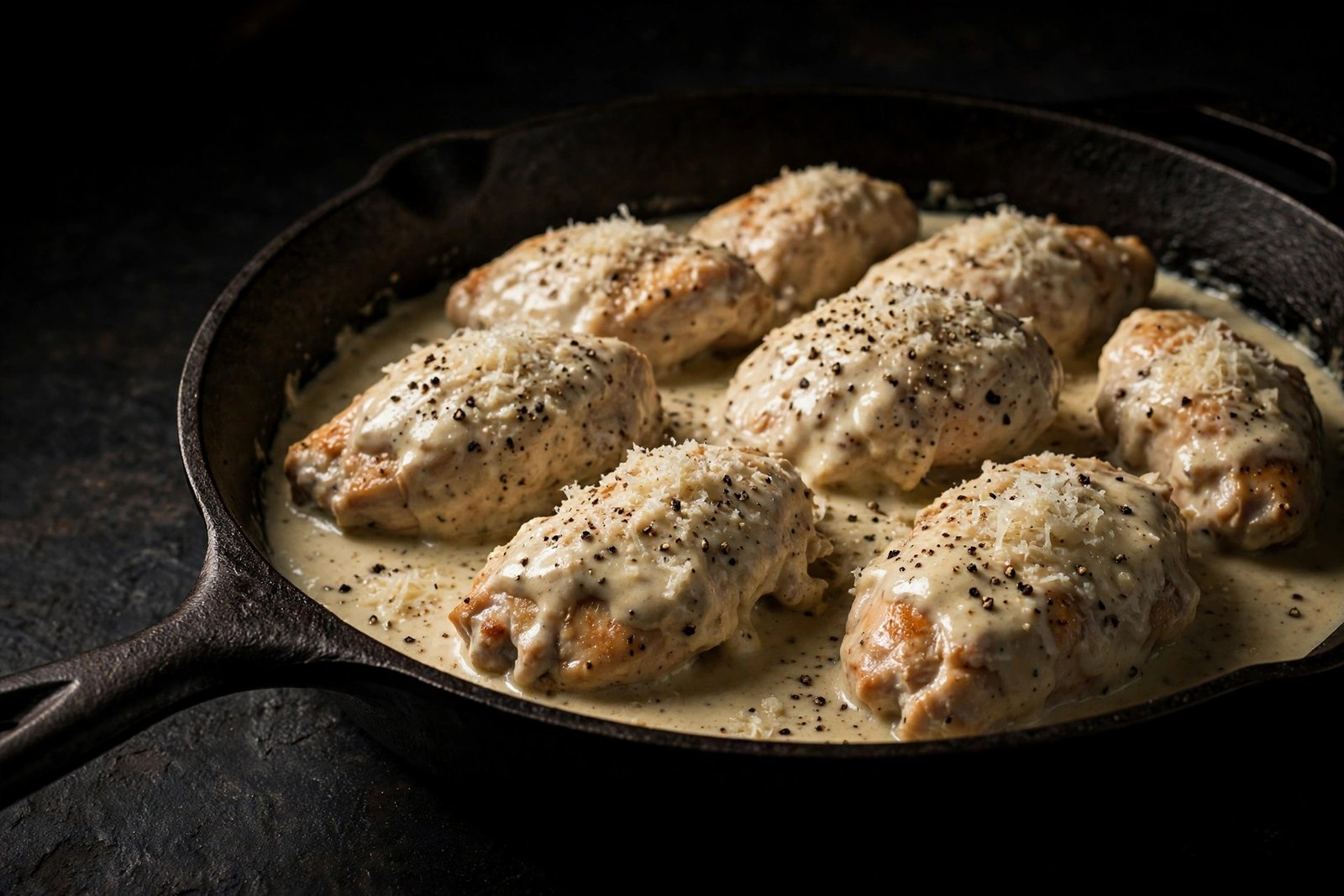
Every family has a weeknight dinner rut, and ours was chicken breasts. I cooked them the same way for months — seasoned, seared, served — until my youngest looked at his plate one Tuesday and said, “chicken again?” with the weary sigh of a food critic twice his age. He was right. I needed a rescue plan, and it came from the most unlikely place: the bottle of Caesar dressing in the fridge door.
I have always been a Caesar salad devotee — that briny, garlicky, Parmesan-packed dressing is one of my favourite flavours on earth. And one evening, staring at those plain chicken breasts, I had the kind of lightbulb moment that makes you feel like a genius: what if the dressing was not a dressing at all? What if it became the sauce? I whisked it into cream with extra Parmesan and garlic, and the result was this silky, tangy, deeply savoury skillet dinner that tasted like a Caesar salad and comfort food had a beautiful baby. The kids who turned their noses up at salad demolished it. Now it is in our permanent weeknight rotation, and that bottle of Caesar dressing has never been just for salads since.
Why You’ll Love This Recipe
This is the recipe I recommend when someone tells me they are bored of chicken. Here is why it works:
- One pan, thirty minutes, zero drama. Everything happens in a single skillet — sear, sauce, simmer, serve. Weeknight cooking does not get more forgiving than this.
- That sauce is dangerously good. Creamy, garlicky, tangy with a whisper of anchovy-like brininess from the Caesar dressing — it is the kind of sauce people quietly spoon up after the chicken is gone.
- Picky-eater approved. Somehow the flavours kids reject in salad form become irresistible in sauce form. I do not fully understand it either, but I am not questioning it.
- Endlessly versatile. Serve it over pasta, rice, mashed potatoes, or with crusty bread. The sauce adapts to whatever your week looks like.
- Simple ingredients, big payoff. Chicken, cream, a good Caesar dressing, Parmesan — nothing exotic, nothing fussy, everything delicious.
Ingredients You’ll Need
Prep Time: 10 minutes | Cook Time: 20 minutes | Total Time: 30 minutes | Servings: 4
- 4 boneless, skinless chicken breasts
- Salt and freshly ground black pepper
- 1 teaspoon garlic powder
- 2 tablespoons olive oil
- 3 cloves garlic, minced
- 240 ml (1 cup) double (heavy) cream
- 120 ml (1/2 cup) Caesar dressing
- 50 g (1/2 cup) freshly grated Parmesan, plus more to serve
- 1 teaspoon Dijon mustard
- 1 teaspoon Worcestershire sauce
- 60 g (2 cups) baby spinach (optional)
- Chopped parsley, to serve
Ingredient Notes
Chicken breasts: Look for breasts of roughly even thickness — if one end is much thicker than the other, pound it gently to even things out so everything cooks at the same rate. Nobody wants one dry end and one raw end. Thighs work beautifully too if you prefer darker meat; just add a few extra minutes of searing time.
Caesar dressing: This is the backbone of the sauce, so use one you genuinely like — a good-quality, full-flavoured dressing with real garlic and Parmesan character. The cheap, sweet, gloopy kind will drag the whole dish down. Taste it first; if you would not put it on a salad, do not put it in this sauce.
Double (heavy) cream: The richness that turns the dressing into a proper sauce. It simmers without splitting and thickens into something silky. Single cream or half-and-half can work but may need a little longer to reduce, and low-fat versions risk curdling — this is not the recipe for skimping.
Parmesan: Freshly grated, always. It melts into the sauce and gives it that salty, nutty depth. The pre-grated kind turns grainy and never quite dissolves. Keep extra for showering over the top at the table.
Worcestershire sauce and Dijon: Small amounts, big impact. They deepen the savoury, tangy notes and make the sauce taste more complex than the sum of its parts. Do not skip them.
How to Make Creamy Chicken Caesar Skillet
- Prep the chicken. Pat the chicken breasts dry and season them generously on both sides with salt, pepper, and garlic powder. If any breast is dramatically thicker at one end, lay it between cling film and give the thick part a few firm whacks with a rolling pin or mallet until it is reasonably even. Even thickness means even cooking — no dry edges, no pink middles.
- Sear until golden. Heat the olive oil in a large skillet over medium-high heat until it shimmers. Lay in the chicken breasts — you should hear an immediate, enthusiastic sizzle — and sear for 5–6 minutes per side without moving them. You are looking for a deep golden-brown crust with caramelised edges. The chicken will not be cooked through yet; that is fine. Transfer to a plate and tent loosely with foil.
- Soften the garlic. Reduce the heat to medium and add the minced garlic to the same pan, stirring for just 30 seconds until fragrant. It should smell sweet and toasty, not sharp. Garlic goes from golden to bitter in seconds, so keep it moving and do not walk away — this is a thirty-second job, not a leave-it-and-check-your-phone job.
- Build the sauce. Pour in the cream, Caesar dressing, Dijon mustard, and Worcestershire sauce, whisking as you go until everything is smooth and combined. Scrape the bottom of the pan with your whisk to release all those browned bits from searing the chicken — that is concentrated flavour dissolving into your sauce. Bring it to a gentle simmer; it should bubble lazily, not boil furiously.
- Melt in the Parmesan. Sprinkle in the grated Parmesan a handful at a time, stirring until each addition melts before adding the next. Let the sauce simmer for 3–4 minutes, stirring occasionally, until it thickens enough to coat the back of a spoon. It will look glossy and smell like the best Caesar salad you have ever met, in warm creamy form.
- Wilt the spinach. If you are using spinach, add it now and stir for about a minute until it just wilts into the sauce, turning silky and dark green. It adds colour, a bit of virtue, and barely any flavour — the stealth vegetable move. If your family revolts at green things, you can skip it with no harm done.
- Return the chicken. Nestle the seared chicken breasts back into the pan, spooning the sauce generously over each piece. Let everything simmer together for 2 minutes so the chicken heats through and absorbs some of that sauce. The chicken should be cooked through — 74°C (165°F) inside — and the sauce should be bubbling gently around it.
- Finish with flair. Scatter over the chopped parsley and an extra snowfall of Parmesan. The green against the creamy sauce looks gorgeous, and the fresh Parmesan adds a salty punch. Bring the whole skillet to the table if you like — it makes a wonderful centrepiece.
- Serve it your way. Spoon the chicken and plenty of sauce over pasta, fluffy rice, or creamy mashed potatoes — or just put out a basket of crusty bread for mopping, which is honestly my favourite option. Make sure everyone gets extra sauce. There is never enough sauce.
Pro Tips
- Do not crowd the pan. If your skillet cannot comfortably fit all four breasts with space between them, sear in two batches. Crowded chicken steams instead of browning, and you will miss out on that golden crust.
- Taste your Caesar dressing first. Dressings vary wildly in saltiness and tang. If yours is very salty, go easy on the added salt; if it is mild, you might want an extra squeeze of lemon at the end.
- Keep the simmer gentle. A rolling boil can make cream sauces split and turn grainy. Lazy bubbles are what you want — patience pays off in silkiness.
- Pound for even cooking. Thirty seconds with a mallet on the thick end of each breast prevents the classic dry-outside, raw-inside tragedy. It is the highest-return two minutes in weeknight cooking.
- Slice to check if unsure. No thermometer? Cut into the thickest breast — the juices should run clear and the meat should be white all the way through with no pink. Better safe than sorry.
- Double the sauce. I am serious. Make extra on purpose. Leftover Caesar cream sauce reheated the next day over pasta is one of the great secret lunches.
Variations
Bacon Caesar skillet: Crisp up 4 rashers of chopped bacon before searing the chicken, then crumble it over the finished dish. Smoky, salty, incredible — the full steakhouse-salad experience in a pan.
Sun-dried tomato version: Stir in a handful of sliced sun-dried tomatoes with the spinach. Their sweet-tart chewiness cuts through the richness beautifully and adds gorgeous ruby colour.
Mushroom Caesar: Sauté sliced mushrooms in the pan after searing the chicken and before adding the garlic. They soak up the sauce and make the whole dish earthier and more substantial.
Low-carb serving: Skip the pasta and serve over zucchini noodles or cauliflower mash. The sauce is naturally low in carbs, so this adapts easily — just add the zoodles at the very end so they do not go soggy.
Storage & Reheating
Leftovers keep in an airtight container in the fridge for up to 3 days. Reheat gently in a skillet over low heat with a splash of cream or milk to loosen the sauce — the microwave works in a pinch but can make the sauce separate, so go low and slow, stirring halfway. I would not freeze this one; cream-based sauces tend to split when thawed, and the chicken texture suffers.
Serving Suggestions
This sauce was born to be mopped up, so think about vehicles. Twirly pasta like fusilli or penne catches the sauce in every ridge. Fluffy white rice or buttery mashed potatoes are classic comfort pairings. For a lighter plate, serve alongside a crisp green salad — a little ironic, a Caesar-style chicken next to a salad, but the freshness balances the richness perfectly. Crusty bread is mandatory in my house. A glass of chilled white wine — Pinot Grigio or an unoaked Chardonnay — rounds it out.
Frequently Asked Questions
Can I use chicken thighs instead of breasts? Yes, and they are arguably even better here — juicier and more forgiving. Use boneless, skinless thighs and sear them for about 6 minutes per side. Everything else stays the same.
My sauce split / looks grainy. What happened? Almost always too-high heat. Cream sauces need a gentle simmer, never a hard boil. If it splits, take it off the heat and whisk in a splash of cold cream — it often comes back together. Next time, keep those bubbles lazy.
Is there anchovy in this? I am serving someone who hates it. Traditional Caesar dressing contains anchovy, and most bottled dressings do too — that is where the briny depth comes from. If it is a concern, look for an anchovy-free dressing, or make the sauce with extra Parmesan and a squeeze of lemon instead.
Can I make this ahead? You can sear the chicken and make the sauce a day ahead, storing them separately in the fridge. Reheat the sauce gently, add the chicken, and simmer until heated through. The flavours actually meld nicely overnight.
What pasta shape works best? Anything with ridges or twists that grabs sauce: penne, fusilli, rigatoni, or farfalle. Long strands like fettuccine work too — the sauce clings beautifully. Honestly, there is no wrong answer here.
Nutrition
Per serving (approximate): 560 calories, 42 g protein, 40 g fat, 6 g carbohydrates. Rich and satisfying, with a solid hit of protein. The numbers assume the sauce is divided among four servings — though in my house, someone always claims a double portion of sauce.