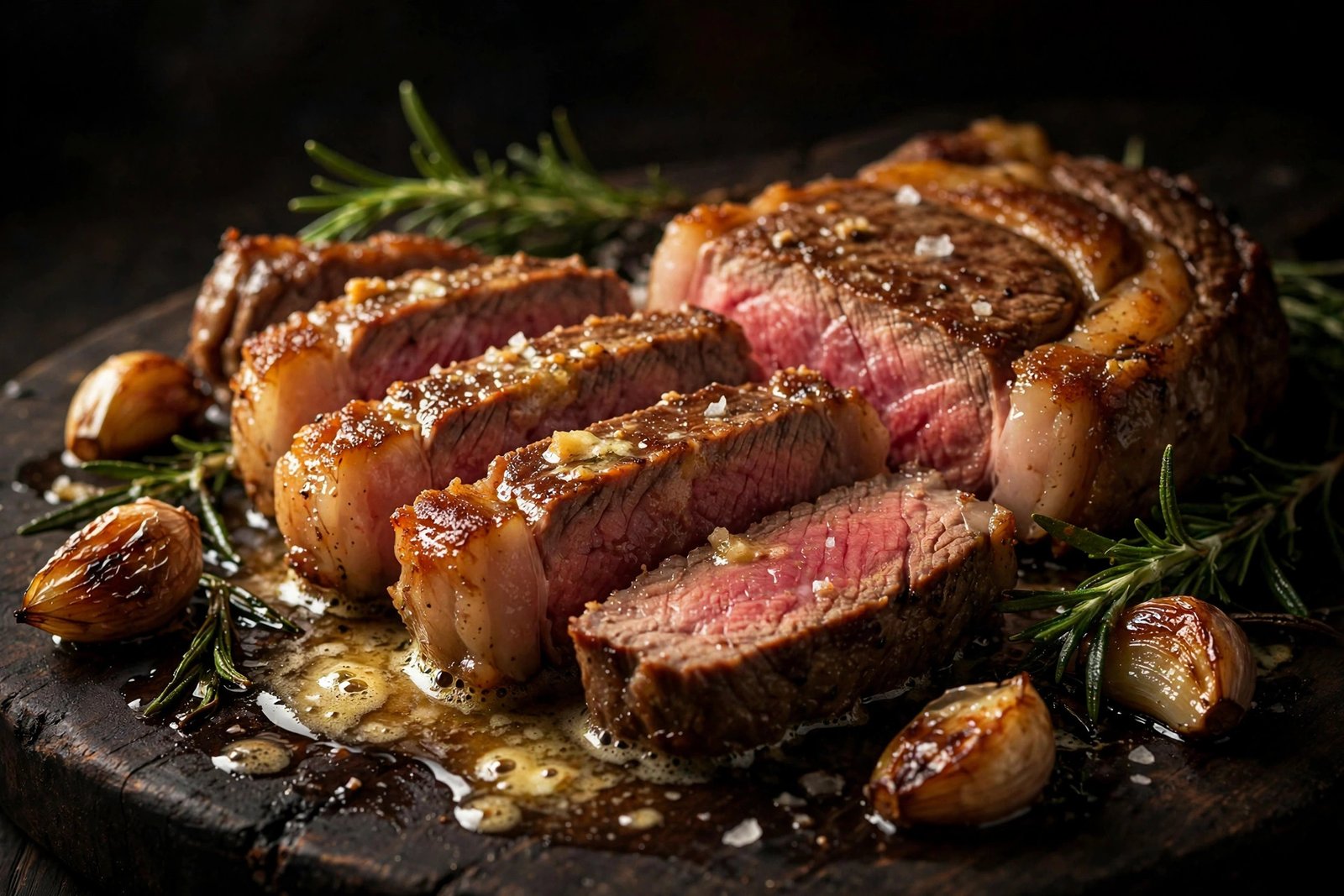
Here is a confession: for years, I was terrible at cooking steak. I would buy a beautiful ribeye, full of hope, and turn it into something grey, chewy, and faintly apologetic. My husband would chew politely and say “it’s fine,” which is what people say when it is very much not fine. I assumed great steak was restaurant magic — something involving salamanders and secret techniques I would never possess.
Then I watched a chef on television do something that changed everything: he got his pan violently hot, seared the steak hard, then dropped in a knob of butter with crushed garlic and herbs and spent the last minute spooning that foaming, fragrant butter over the meat again and again. That was it. That was the whole trick. The first time I tried it, the crust crackled, the butter smelled like heaven, and the inside was pink and juicy. Now our date nights at home beat most restaurants, and this garlic butter ribeye is the reason why. If I can go from steak-ruiner to steak-hero with one technique, so can you.
Why You’ll Love This Recipe
This is the steakhouse experience without the steakhouse bill. Here is what makes it so good:
- That butter baste is pure magic. Spooning foaming garlic butter over the steak in the final minutes does three things at once: it cooks the top gently, infuses every bite with garlic and herbs, and gives you a glossy pan sauce for free.
- Ready in 25 minutes. Ten minutes of prep (mostly waiting for the steaks to warm up), fifteen minutes of cooking. Faster than ordering in, infinitely better.
- Just a handful of ingredients. Steak, butter, garlic, thyme, rosemary, salt, pepper. When the ingredients are this good, you do not need much else.
- Works with the gear you already own. A heavy skillet — cast iron is ideal but any heavy pan works — and a pair of tongs. No special equipment, no fuss.
- Endlessly impressive. Serve this to guests and watch the conversation stop for the first three bites. It never fails.
Ingredients You’ll Need
Prep Time: 10 minutes | Cook Time: 15 minutes | Total Time: 25 minutes | Servings: 2
- 2 ribeye steaks (about 300 g / 10 oz each, 4 cm / 1.5 inches thick)
- Salt and freshly ground black pepper
- 1 tablespoon vegetable oil
- 60 g (4 tablespoons) unsalted butter
- 4 cloves garlic, crushed
- 3–4 sprigs fresh thyme
- 1 sprig fresh rosemary
Ingredient Notes
Ribeye steaks: Ribeye is the king of steakhouse cuts for a reason — that generous marbling of fat melts during cooking and bastes the meat from within, keeping it juicy and deeply beefy. Look for steaks at least 4 cm thick; thin steaks overcook before they can develop a proper crust. Let the butcher’s marbling be your guide: more white flecks means more flavour.
Unsalted butter: This becomes both the basting medium and the sauce, so use butter you would happily eat on toast. Unsalted gives you control over seasoning. European-style butter with higher fat content is a lovely upgrade if you want to be fancy.
Garlic: Crushed, not minced — you want the cloves to perfume the butter without burning to bitter little bits in the hot pan. Give each clove a good whack with the side of your knife and toss them in whole.
Thyme and rosemary: Hardy herbs that can take the heat. They sizzle in the butter and release their oils, turning the basting butter into something truly aromatic. Fresh is best here; dried herbs would scorch.
Vegetable oil: Used for the initial sear because it has a higher smoke point than butter or olive oil. You need that ripping-hot pan without a kitchen full of smoke. Any neutral high-heat oil works — avocado oil is another good choice.
How to Make Garlic Butter Ribeye Steak
- Bring the steaks to room temperature. Take the ribeyes out of the fridge 30 minutes before cooking and pat them very dry with paper towels — press firmly, both sides. Then season generously with salt and freshly ground black pepper, more than feels polite. A thick steak needs assertive seasoning to flavour the interior, not just the surface.
- Heat the pan until it is genuinely hot. Set a heavy skillet — cast iron is the dream — over high heat and add the vegetable oil. Wait until the oil shimmers and just begins to smoke, with the faintest wisp rising. This takes longer than you think, a good 3–4 minutes. An underheated pan is the number one cause of grey, sad steak, so be patient here.
- Sear the first side — and do not touch it. Lay the steaks in the pan away from you (so any spatter goes the other way) and leave them completely alone for 3 minutes. You will hear an aggressive, confident sizzle. Fight the urge to peek or press; the crust is forming through direct contact, and lifting the steak interrupts it. When you finally lift a corner, it should be deeply browned and crackling.
- Flip and sear the second side. Turn the steaks with tongs — never a fork, which pierces the meat and lets juices escape — and sear the second side for another 3 minutes. The kitchen should smell incredible by now: beefy, caramelised, promising. If your steaks are very thick, use the tongs to hold them on their fatty edges for 30 seconds to render that fat cap.
- Drop the heat and add the flavour. Reduce the heat to medium and add the butter, crushed garlic, thyme sprigs, and rosemary to the pan. The butter will melt rapidly and start to foam, hissing around the herbs. Swirl the pan so everything mingles. This is where the magic starts.
- Baste, baste, baste. Tilt the pan toward you so the foaming garlic butter pools at the far edge, then spoon it continuously over the steaks for 1–2 minutes. Keep it moving — scoop and pour, scoop and pour. Watch the butter turn golden and smell increasingly of garlic and herbs. The steaks will glisten, and the tops will cook gently in the hot butter while the bottoms finish in the pan.
- Check the temperature. For rare, pull the steaks at 52°C (125°F); for medium-rare, 57°C (135°F). Insert the thermometer horizontally into the centre of the thickest part. Remember the temperature will rise a few degrees as the steaks rest, so pull them just shy of your target. If you do not have a thermometer, the steaks should feel springy with a slight give when pressed.
- Rest the steaks. Transfer to a warm plate, spoon over some of that glorious garlic butter from the pan, and rest for 5–10 minutes. The fibres relax and reabsorb their juices. Cut too soon and you will watch all that flavour bleed out onto the plate — the hardest, most important wait in cooking.
- Slice and serve. Slice against the grain into thick strips, so each piece shows that perfect gradient: dark crust, rosy centre. Arrange on warm plates and drizzle with the remaining pan juices and the softened garlic cloves. Serve immediately, while everything is glistening.
Pro Tips
- Dry surface, hot pan — that is the whole sear equation. Moisture steams; dryness browns. Pat thoroughly, heat patiently, and you will get a crust that crackles.
- Season more aggressively than feels natural. A thick steak seasoned timidly tastes bland in the middle. Be bold with the salt and pepper.
- Use tongs, never a fork. Piercing the meat lets precious juices escape. Tongs keep everything sealed inside where it belongs.
- Do not add the butter too early. Butter burns at searing temperatures. It goes in only after you reduce the heat — that way it foams and perfumes instead of scorching.
- Butter-baste with conviction. A few half-hearted spoonfuls will not do it. Continuous basting for the full minute or two is what builds that glossy, flavour-soaked finish.
- Warm your plates. A hot steak on a cold plate loses heat fast. A quick warm in a low oven keeps everything at its best until the last bite.
Variations
Blue cheese butter: Mash a knob of blue cheese into the butter before it goes in the pan. It melts into a funky, savoury sauce that is outrageous on ribeye.
Café de Paris style: Add a teaspoon of Dijon mustard, a pinch of curry powder, and a squeeze of lemon to the basting butter. It sounds odd; it tastes like a Swiss steakhouse secret.
Smoky chipotle version: Swap the herbs for a sliced chipotle chilli in adobo and a pinch of smoked paprika in the butter. Smoky, spicy, and brilliant with a cold beer.
Reverse sear for extra-thick steaks: If your ribeyes are over 5 cm thick, warm them in a 120°C (250°F) oven to 45°C internal first, then sear hard for 1 minute per side and butter-baste. Edge-to-edge pink perfection.
Storage & Reheating
Leftover steak keeps for up to 3 days in the fridge, wrapped tightly. Cold sliced steak is fantastic in sandwiches with horseradish and rocket — arguably the best sandwich filling known to humanity. To reheat without ruining it, warm slices gently in a 140°C (275°F) oven until just warmed through, or flash them in a hot pan for 30 seconds per side. Never microwave steak unless you enjoy chewing leather.
Serving Suggestions
Keep it classic steakhouse: crisp golden chips or creamy mashed potatoes, a simple green salad with sharp dressing to cut the richness, and maybe some roasted mushrooms or creamed spinach on the side. A pile of rocket with shaved Parmesan and lemon is my personal favourite — peppery, fresh, and done in two minutes. For wine, pour a big red: Malbec, Cabernet Sauvignon, or a spicy Syrah.
Frequently Asked Questions
How do I know when the steak is done without a thermometer? Use the touch test: press the centre of the steak with your finger. Rare feels soft and squishy like the fleshy part of your relaxed palm; medium-rare springs back gently. But honestly, a ten-pound thermometer removes all doubt — worth every penny.
Can I cook this on a barbecue instead? Absolutely — arguably even better. Sear over the hottest part of the grill, then move to a cooler zone, add the butter and aromatics in a small cast-iron pan on the grill, and baste the same way.
Why did my steak turn out grey instead of browned? Almost certainly the pan was not hot enough, or the steak surface was wet. Next time, pat the steaks drier than you think necessary and give the pan a full 3–4 minutes to heat until the oil smokes.
Can I use a different cut? Yes — this method loves any well-marbled thick steak: sirloin, strip, or even a thick fillet (though fillet needs less searing time). Adjust cooking time to thickness and always go by temperature.
Is it safe to eat steak pink in the middle? Yes. With whole cuts of beef, bacteria live on the surface, which gets fully seared. That is why rare and medium-rare steak are standard — just make sure the exterior is well browned.
Nutrition
Per serving (approximate): 780 calories, 52 g protein, 62 g fat, 2 g carbohydrates. This is unapologetic indulgence — a proper steakhouse plate. The numbers assume one 300 g steak per person with a generous share of the garlic butter, because nobody is leaving that butter in the pan.