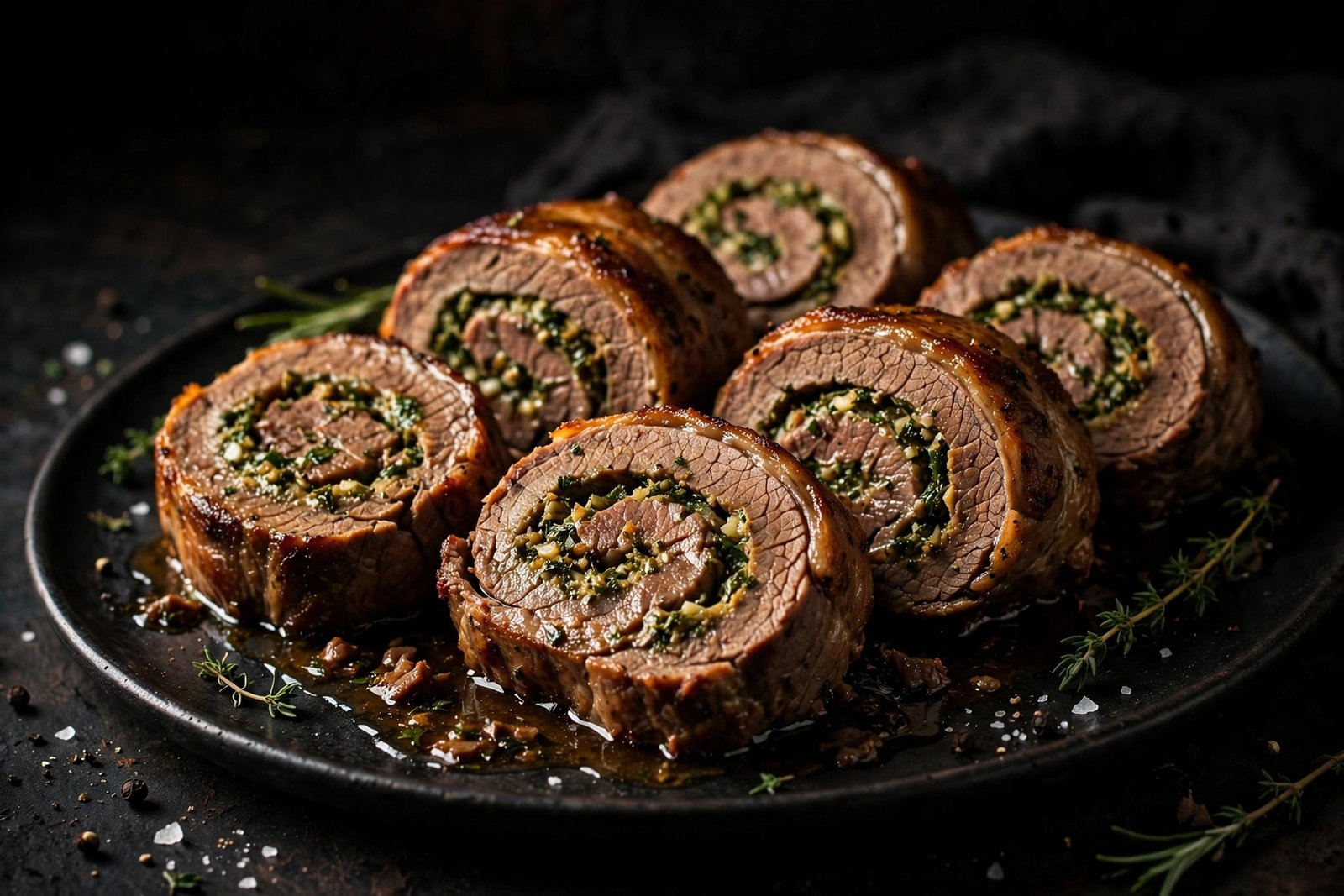
The first time I saw a beef roulade sliced open, I actually gasped a little. It was at my friend Elena’s house — her grandmother’s Sunday table, the kind with a tablecloth, too many forks, and a sauce that had been simmering since morning. Elena brought out this burnished, twine-tied log of beef, snipped the strings, and cut into it to reveal the most beautiful spiral: ruby-red meat wound around green herbs, white Parmesan, and ribbons of roasted red pepper. Everyone at that table nodded like this was completely normal. For me, it was a revelation.
I went home and tried it the following weekend, and mine sprang open in the oven like a jack-in-the-box. Half the filling ended up on the roasting tray. But here is the thing about roulade: it looks like a magic trick and cooks like a simple roast once you know two things — roll it tighter than feels sensible, and tie it like you mean it. This version, with its garlicky herb paste and spinach filling, has become my secret weapon for dinner parties. It takes a humble, affordable cut of flank steak and turns it into something people photograph before they eat. And that spiral? It never gets old.
Why You’ll Love This Recipe
If you have never rolled a piece of beef before, this is the recipe to start with. Here is why it works so well:
- It looks like you hired a caterer. Those spiral slices are pure drama on a platter. Guests will assume you spent all day on it, and you can simply smile mysteriously.
- Flank steak is a budget-friendly hero. This cut costs a fraction of tenderloin, and the pounding, seasoning, and roasting transform it into something genuinely tender and flavour-packed.
- Make-ahead friendly. You can assemble and tie the whole roulade the morning of your dinner party, then keep it wrapped in the fridge until roasting time. Less last-minute chaos.
- Feeds a crowd generously. One roulade slices into a generous platter that comfortably serves six as a main — perfect for Sunday lunches and holiday tables.
- The leftovers are legendary. Cold roulade slices on crusty bread with a smear of mustard might be better than the original dinner. I am only slightly exaggerating.
Ingredients You’ll Need
Prep Time: 25 minutes | Cook Time: 40 minutes | Total Time: 1 hour 5 minutes | Servings: about 6
- 1 flank steak (about 1 kg / 2.2 lb), butterflied
- Salt and freshly ground black pepper
- 4 cloves garlic, minced
- 60 ml (1/4 cup) olive oil
- 2 tablespoons fresh rosemary, chopped
- 2 tablespoons fresh thyme leaves
- 60 ml (1/4 cup) fresh parsley, chopped
- 40 g (1/2 cup) breadcrumbs
- 30 g (1/3 cup) grated Parmesan cheese
- 100 g (3.5 oz) baby spinach, wilted and squeezed dry
- 1 roasted red pepper, sliced (optional)
- Kitchen twine
- 2 tablespoons beef stock or red wine, for the pan
Ingredient Notes
Flank steak: Ask your butcher to butterfly it for you — most will do it happily, and it saves you the fiddliest part of the job. You want one large, even rectangle of meat. Flank has long, visible muscle fibres, which is why we slice the finished roulade across the grain later; that is what keeps every bite tender. Skirt steak can work in a pinch, though it is thinner and trickier to roll.
Fresh herbs: Rosemary, thyme, and parsley are the backbone of the filling’s flavour, and fresh really does matter here. Dried herbs would taste dusty and one-dimensional inside the roll. If you are short on one of them, just increase the others — the blend is forgiving.
Baby spinach: Wilt it first, then squeeze it absolutely dry in a clean tea towel. I mean really squeeze — like you are wringing out a swimsuit. Any leftover water will steam inside the roulade and turn your filling soggy.
Roasted red pepper: Technically optional, but those sweet red ribbons make the spiral dramatically prettier and add a lovely sweetness. Jarred roasted peppers are completely fine; just pat them dry.
Kitchen twine: Do not skip this or substitute with something creative. Regular cotton kitchen twine is heat-safe and cheap. In a real emergency, wooden toothpicks or small skewers can pin the seam, but twine gives you the neatest, tightest roll.
How to Make Beef Roulade with Garlic Herb Filling
- Pound the steak evenly. Lay the butterflied flank steak flat between two sheets of cling film and pound it with a meat mallet (or a heavy rolling pin) to an even 1 cm thickness. You are aiming for a uniform rectangle — thin edges and thick middles roll lopsided and cook unevenly. The meat will spread out satisfyingly under the mallet with a soft thudding sound. Peel off the cling film and season both sides well with salt and pepper.
- Make the garlic-herb paste. In a bowl, stir together the minced garlic, olive oil, chopped rosemary, thyme leaves, parsley, breadcrumbs, and grated Parmesan until you have a coarse, fragrant paste. It should smell intensely savoury — like the inside of an Italian deli. The breadcrumbs absorb the oil and will toast inside the roll, giving the filling some welcome texture.
- Spread the filling. Spoon the garlic-herb paste over the surface of the steak and spread it in an even layer, leaving a 2 cm border clear around all the edges. That border matters: filling that reaches the very edge squirts out during rolling and makes a mess. Think of it like leaving the crust on a pizza.
- Layer the spinach and peppers. Scatter the squeezed-dry spinach evenly over the herb paste, then arrange the roasted red pepper slices in stripes along the length. Press everything down gently with your hands so it compacts slightly. You should already be able to picture the spiral taking shape.
- Roll it up — tightly. Starting from one long side, roll the steak up into a firm log, tucking as you go and pulling back slightly on the roll to keep tension. Roll tighter than feels natural; a snug roll is a neat spiral, while a loose roll unravels and looks sad. Tuck in any filling that tries to escape at the ends.
- Tie it like you mean it. Slide lengths of kitchen twine under the roulade and tie firmly at 4–5 cm intervals along the whole log, finishing with a knot. Then tie one long piece lengthwise around the entire roll to hold the ends in. This is the step my first attempt skipped, and the difference is night and day. A well-tied roulade holds its beautiful shape through searing and roasting.
- Sear for colour. Preheat the oven to 200°C (400°F). Heat a drizzle of oil in a large oven-safe pan over medium-high heat until shimmering. Sear the roulade on all sides, turning every couple of minutes with tongs, until deeply browned all over — about 8 minutes in total. Listen for the sizzle and watch for that rich mahogany crust; this browning is where so much of the flavour comes from.
- Deglaze and roast. Pour the beef stock or red wine into the pan — it will hiss and steam dramatically, releasing all those caramelised bits from the bottom. That is liquid gold. Transfer the whole pan to the oven and roast for 30–35 minutes, until a thermometer in the centre reads about 60°C (140°F) for a rosy medium. The kitchen will smell of roast beef and herbs, and you will have to stop yourself opening the oven every five minutes.
- Rest, then snip. Move the roulade to a cutting board and rest it for a full 10 minutes. This pause lets the juices settle back into the meat so they do not flood the board when you slice. Snip off and discard all the twine — do a careful check, because nobody wants to bite into string.
- Slice and serve. Using your sharpest knife, cut the roulade into 2 cm rounds with smooth, confident strokes — sawing tears the spiral. Each slice should show that gorgeous pinwheel of meat, herbs, and pepper. Arrange on a warm platter and spoon the glossy pan juices over the top. Stand back and accept the compliments.
Pro Tips
- Even thickness is everything. Spend the extra two minutes pounding the steak uniformly. A lopsided roll cooks unevenly — thin parts dry out while thick parts stay underdone.
- Squeeze that spinach like your dinner depends on it. Because it does. Wet spinach is the number one cause of a soggy, weeping roulade.
- Chill the tied roulade for 30 minutes before searing. A brief rest in the fridge firms everything up and helps the roll hold its shape in the hot pan. This is also your make-ahead window.
- Do not overcook it. Flank steak dries out fast past medium. Pull the roulade at 60°C (140°F) and let carryover heat finish the job during the rest.
- Slice across the grain. The spiral slices already mostly do this for you, but keep your knife perpendicular to those long muscle fibres for maximum tenderness.
- Save every drop of pan juice. Those deglazed drippings are concentrated flavour. Spoon them over the slices, or whisk in a knob of cold butter for an instant pan sauce.
Variations
Classic Italian braciole: Simmer the seared, tied roulade in your favourite tomato sauce on low for about 90 minutes instead of oven-roasting. The meat turns meltingly tender and the sauce picks up all that beefy, herby richness. Serve over pasta and thank me later.
Extra-cheesy version: Lay thin slices of provolone or mozzarella over the herb paste before rolling. The cheese melts into gooey pockets inside the spiral — gloriously indulgent, and children go mad for it.
Mushroom and blue cheese: Swap the spinach for sautéed mushrooms (cooked until all their liquid evaporates) and crumble blue cheese into the herb paste. Earthy, punchy, and wonderful with a glass of red.
Slow-braised comfort version: After searing, nestle the roulade into a Dutch oven with beef stock, a glass of red wine, and some chunky vegetables. Braise at 160°C (325°F) for 2 hours until spoon-tender. Different texture, same wow factor.
Storage & Reheating
Cooled leftovers keep beautifully in the fridge for up to 3 days — wrap the unsliced portion tightly in foil or cling film so it does not dry out. To reheat, warm slices gently in a covered pan with a splash of stock over low heat, or in a 160°C (325°F) oven wrapped in foil for 12–15 minutes. Avoid the microwave, which toughens the meat. The cooked roulade also freezes well for up to 2 months; thaw overnight in the fridge before reheating.
Serving Suggestions
This is a natural centrepiece, so keep the sides simple and generous. Creamy garlic mashed potatoes are practically mandatory — they were made for those pan juices. A crisp green salad with a sharp vinaigrette cuts through the richness, and roasted root vegetables (carrots, parsnips, red onions) echo the cosy, Sunday-dinner mood. For bread, a crusty loaf to mop the plate is non-negotiable in my house. Wine-wise, pour something Italian and hearty: a Chianti Classico or a Montepulciano d’Abruzzo.
Frequently Asked Questions
Can I use a different cut of beef? Flank is ideal, but top round (butterflied) or skirt steak can work. Avoid very thick cuts like chuck — they will not roll. Whatever you use, pound it to that even 1 cm thickness and slice the finished roulade across the grain.
How do I stop the roulade unrolling in the oven? Three things: roll it very tightly, tie it at close intervals with proper kitchen twine, and chill the tied roll for 30 minutes before searing. Do all three and it will hold its shape like a dream.
What internal temperature am I aiming for? About 60°C (140°F) for medium, pulled from the oven — the temperature will rise a few degrees as it rests. If you prefer it more done, go to 65°C (150°F), but I would not push past that with flank steak.
Can I assemble it the day before? Yes, and it is a brilliant dinner-party move. Assemble, roll, and tie the roulade up to 24 hours ahead, wrap it tightly, and refrigerate. Take it out 30 minutes before cooking so it is not fridge-cold when it hits the pan.
What if I do not have kitchen twine? Wooden toothpicks or small metal skewers pushed through the seam every few centimetres will hold it in a pinch — just count them so you remember to remove them all. But honestly, a ball of kitchen twine costs very little and lasts for years. Worth owning.
Nutrition
Per serving (approximate): 480 calories, 38 g protein, 26 g fat, 14 g carbohydrates. These are estimates that will shift a little with your exact cut of steak and how thick you slice the rounds. Plenty of protein, loads of flavour — a fair trade, I would say.